
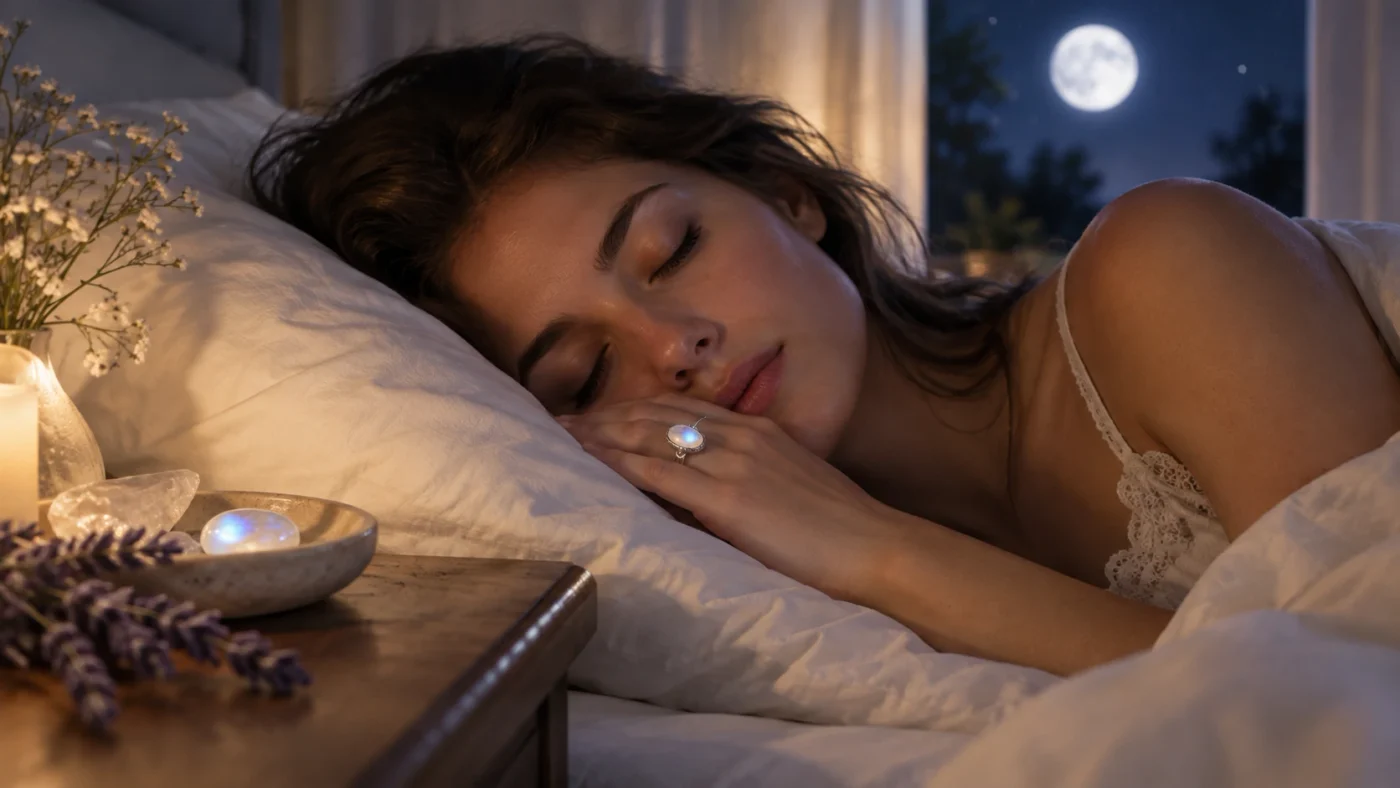
Moonstone is often associated with sleep, dreams, calmness and nighttime rituals, but there is an important distinction to make from the beginning: there is currently no strong scientific evidence showing that moonstone itself can directly make you fall asleep faster or treat insomnia. Its reputation as a “sleep stone” comes mainly from gemstone traditions, symbolism surrounding the moon, and the relaxing rituals that people create around it.
That does not necessarily make moonstone irrelevant at bedtime. Sleep is influenced by much more than simply feeling tired. Your evening routine, exposure to light, stress level, bedroom environment and the habits you repeat before bed can all help tell your brain that the active part of the day is ending. A meaningful object such as moonstone can therefore become part of a consistent wind-down ritual, particularly if its appearance and symbolism already make you feel peaceful. 🌙
The most useful way to look at moonstone is therefore not as a sleeping pill made from crystal, but as a beautiful object that may help create an atmosphere of intentional relaxation. In this guide, we will separate traditional moonstone beliefs from established sleep science, compare different ways of keeping moonstone near you at night, explain whether you should actually wear it while sleeping, and build a practical bedtime ritual around it.
🌙 Is Moonstone Good for Sleep? The Quick Answer

Moonstone may be a pleasant addition to a relaxing bedtime routine, but it has not been scientifically proven to improve sleep on its own. People traditionally associate the gemstone with calmness, intuition, dreams and emotional balance, which explains why it is so frequently used during meditation and nighttime rituals.
If holding moonstone, looking at it, journaling beside it or placing it on your nightstand encourages you to slow down before bed, the ritual itself may become useful. However, anyone experiencing persistent insomnia should not rely on a gemstone as a substitute for established sleep practices or professional medical advice.
Why Is Moonstone So Strongly Associated With Sleep?
Few gemstones visually belong to nighttime as naturally as moonstone. Its famous floating glow, known in gemology as adularescence, creates the impression that light is moving beneath the surface of the stone. Depending on the specimen and lighting, that glow can appear white, silvery or blue and can shift as the gemstone moves.
This visual connection with moonlight has played an enormous role in the symbolism surrounding moonstone. Long before modern discussions about sleep hygiene existed, people were already linking the stone with the moon, intuition, changing cycles, femininity, dreams and introspection. Many modern crystal traditions continue that association today, which is why moonstone appears frequently in evening meditation routines and discussions about crystals for sleep.
There is also a psychological reason the idea feels intuitive. Nighttime rituals often work best when they include signals that are clearly different from the stimulation of daytime life. Bright screens, work emails and constant notifications tell your brain to remain engaged; dim light, quiet activities and familiar objects can signal the opposite. Because moonstone has such a soft and subdued visual identity, it fits naturally into this slower atmosphere.
Think of moonstone as a cue, not a cure. The stone itself does not need to possess a measurable sedative effect to become part of a meaningful routine that reminds you it is time to slow down.
Does Moonstone Actually Help You Sleep? What Science Says
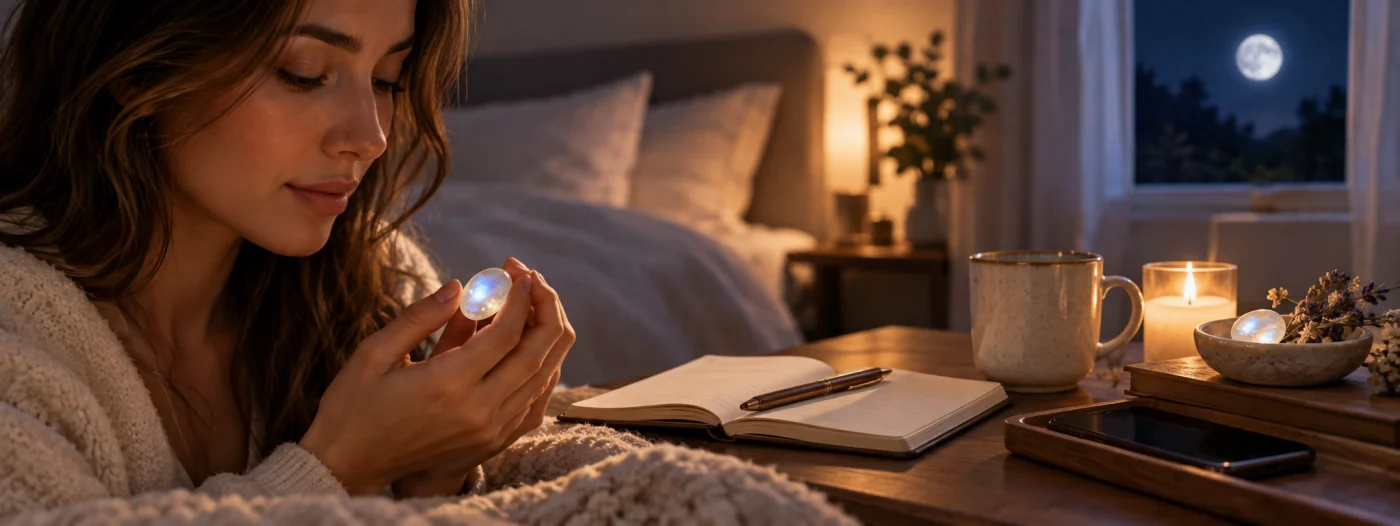
This is where it is important to separate an enjoyable spiritual tradition from a medical claim. There is no established clinical evidence showing that moonstone itself treats insomnia, increases deep sleep, changes melatonin production or reliably shortens the time required to fall asleep. Claims describing those effects should therefore be treated as traditional or personal beliefs rather than proven physiological facts.
What sleep research does support much more clearly is the importance of the behavior surrounding bedtime. Consistent sleep and wake times, reduced stimulation before bed, a dark and quiet sleeping environment, managing caffeine and nicotine, and allowing time to wind down are all much more established parts of healthy sleep habits. Relaxation techniques are also used as components of evidence-based approaches to insomnia.
This distinction actually gives moonstone a more realistic role. Instead of asking, “Can this gemstone chemically make me sleepy?”, a better question is: “Can I use moonstone as part of a relaxing routine that helps me stop working, put my phone away and prepare myself mentally for sleep?”
For some people, the answer may genuinely be yes. A repeated ritual can become familiar over time. If you place your phone aside, dim the lights, hold your moonstone for a few minutes, breathe slowly and begin journaling every evening, the gemstone may eventually become mentally associated with that quieter part of your day. The useful element is the entire ritual rather than an invisible sleep-inducing property contained inside the mineral.
Moonstone and Sleep: Belief vs Evidence 📊
Because crystal information online often mixes folklore, personal testimony and medical terminology together, the following comparison makes the difference much clearer.
| Claim | Traditional Association | Scientific Evidence | Practical Interpretation |
|---|---|---|---|
| Moonstone promotes calm | Commonly associated with emotional softness and balance | No established direct calming effect from the mineral itself | It may become a comforting object within a relaxing ritual |
| Moonstone improves sleep | Frequently described as a nighttime or dream stone | Not clinically demonstrated as a sleep treatment | Use it alongside healthy sleep habits rather than instead of them |
| Moonstone affects dreams | Traditionally linked to intuition and dream symbolism | No reliable evidence that moonstone changes dream content | Keeping a dream journal may make you remember dreams more consciously |
| Moonstone can support meditation | Widely used in crystal meditation traditions | Relaxation practices can be useful, although the gemstone itself is not proven to create the effect | Use the stone as a visual or tactile focus during relaxation |
Why a Moonstone Bedtime Ritual Can Still Feel Relaxing
Humans respond strongly to routines. Think about how quickly certain actions begin to create associations: making coffee can signal the beginning of the morning, changing into workout clothes can place you mentally into exercise mode, and brushing your teeth can become one of the final signals of the evening. A bedtime ritual works in a similar way.
Moonstone can become one small component of this transition. Its usefulness is greatest when it encourages another positive behavior. Perhaps taking off your moonstone jewelry reminds you to put your phone away. Perhaps placing the stone beside your journal reminds you to write down tomorrow’s tasks instead of mentally rehearsing them in bed. Perhaps holding it during several minutes of slow breathing makes meditation feel more tangible and enjoyable.
This is considerably more realistic than expecting the stone to force the body into sleep. The goal is not to stare at moonstone until unconsciousness arrives. The goal is to use it as an object around which you can build a repeatable, pleasant and low-stimulation evening routine.
A Simple Moonstone Sleep Ritual You Can Try Tonight 🌙
You do not need an elaborate altar, dozens of crystals or a highly spiritual routine to experiment with moonstone before bed. In fact, simplicity is often better because a ritual you can repeat consistently is far more useful than an impressive routine you abandon after three evenings.
Step 1: Begin your wind-down before getting into bed
Choose a short period before sleep during which you deliberately reduce stimulation. Dim unnecessary lights, finish work-related activities and move your phone away from your immediate sleeping area if possible. The aim is to create a clear boundary between the active part of your evening and your sleep preparation.
Step 2: Hold or observe your moonstone
Place the moonstone in your palm or simply look at it under soft light for a minute. Notice its shape, temperature, reflections and changing adularescence. This is not about forcing a mystical experience. You are simply giving your attention to one quiet physical object instead of allowing your thoughts to jump between notifications, conversations and tomorrow’s responsibilities.
Step 3: Slow your breathing
Use several minutes of comfortable, unforced breathing. The exact counting method matters less than avoiding strain. Let your shoulders relax, unclench your jaw and allow the evening to become physically quieter. If holding the moonstone gives your hands something pleasant to focus on, keep it there.
Step 4: Write down whatever your mind keeps repeating
If you tend to mentally plan tomorrow while lying in bed, keep a small notebook nearby. Write down appointments, unfinished tasks or anything you are afraid you might forget. You can also record one thought, intention or moment of gratitude. Moonstone’s traditional association with reflection makes it particularly easy to incorporate into this type of journaling ritual without pretending the gemstone itself is responsible for your sleep.
Step 5: Put the moonstone somewhere safe
Once the ritual is finished, place the stone or jewelry piece on a soft dish, fabric pouch or designated place on your nightstand. This creates a final repeated gesture: the day is finished and the jewelry rests when you rest.
Moonstone Meditation Video 🎥
If you prefer guided relaxation rather than sitting quietly on your own, a moonstone-themed meditation can complement the ritual. The following video is specifically centered on moonstone and reflection. Consider it a relaxation resource rather than scientific proof that moonstone has a direct medical effect on sleep.
One important practical point: if you use a meditation video close to bedtime, try not to turn the experience into another hour of scrolling. Starting one intentional video and then putting the screen away is very different from moving immediately into social media, messages or autoplay recommendations.
Where Should You Put Moonstone While You Sleep?
“Using moonstone for sleep” does not automatically mean that the gemstone needs to remain physically attached to your body all night. In many cases, keeping it nearby is more comfortable and protects the jewelry better. The ideal location depends on whether you own a loose stone, pendant, ring or another piece of jewelry.
| Placement | Comfort | Jewelry Protection | Best For |
|---|---|---|---|
| Nightstand | ★★★★★ | ★★★★★ | Most people; easy and practical |
| Soft jewelry dish | ★★★★★ | ★★★★★ | Moonstone rings and pendants |
| Under your pillow | ★★★☆☆ | ★★☆☆☆ | Small loose stones only; not raised jewelry settings |
| Worn as jewelry | ★★☆☆☆ | ★★☆☆☆ | Only comfortable, low-profile pieces and careful sleepers |
For most people, the nightstand is the best compromise. The moonstone remains visually present in your nighttime environment but is not being rubbed against bedding, compressed under your body or exposed to unconscious movements for several hours.
Should You Actually Sleep While Wearing Moonstone?
It is possible to keep some moonstone jewelry on overnight, but possibility and practicality are two different things. Rings may press into neighboring fingers or catch on bedding, while chains can twist, snag or simply become uncomfortable during sleep. Raised gemstone settings also experience unnecessary friction when worn for eight hours while you move unconsciously.
Moonstone is not an exceptionally hard gemstone. It generally sits around 6 to 6.5 on the Mohs hardness scale, meaning it deserves more thoughtful treatment than very hard gemstones. That does not make it unsuitable for jewelry; it simply means there is little reason to expose a cherished piece to unnecessary nightly wear if keeping it beside the bed gives you the same symbolic experience.
If you are specifically wondering about wearing the gemstone throughout the night, our complete guide on should you sleep with moonstone? goes deeper into ring settings, comfort, nighttime movement and jewelry preservation.
Moonstone Ring, Necklace or Loose Stone: Which Is Best Before Bed?
The form of moonstone you use can change the experience considerably. A loose polished stone is ideal for meditation because it can sit comfortably in the palm and then return to a bedside dish. A ring is highly visual and can work beautifully as a daytime reminder, but hands experience constant contact with objects and bedding. A pendant is easy to hold while relaxing, although most people are better off removing the chain before actually falling asleep.
| Moonstone Form | Best Use at Night | Main Advantage | Main Drawback |
|---|---|---|---|
| Ring | Wear during your evening ritual, then remove | Beautiful and easy to see during meditation or journaling | More exposed to friction and impact |
| Necklace | Wear during the wind-down period, remove before sleep | Keeps moonstone close without exposing it to hand impacts | Chains can twist or snag overnight |
| Loose stone | Meditation, breathing, bedside placement | Simple and comfortable to hold | Easy to misplace if very small |
If you enjoy the feeling of moonstone near the upper body during your evening routine, a pendant can be an elegant alternative to keeping a gemstone on your hands. You can explore our Moonstone Necklace collection for designs that work beautifully during evening wear before being placed safely aside for the night. ✨
Moonstone vs Other Popular “Sleep Crystals”
Moonstone is not the only gemstone commonly associated with evening rituals. Amethyst and rose quartz are also frequently mentioned in crystal traditions. These associations should not be confused with medical sleep effects, but comparing their symbolism can help you choose a stone whose appearance and meaning genuinely appeal to you.
| Stone | Common Traditional Association | Visual Mood | Best Ritual Use |
|---|---|---|---|
| Moonstone | Intuition, dreams, cycles, reflection | Luminous, soft, lunar | Journaling, meditation, intention-setting |
| Amethyst | Peace, clarity, meditation | Deep violet, contemplative | Quiet meditation and visual focus |
| Rose Quartz | Love, comfort, emotional gentleness | Warm, soft pink | Gratitude and self-reflection rituals |
From a practical point of view, there is no need to search endlessly for the supposedly “strongest” sleep crystal. If one stone makes your evening ritual more enjoyable, that is already a better reason to choose it than an exaggerated promise that a particular mineral will guarantee eight uninterrupted hours of sleep.
The Sleep Habits That Matter More Than the Crystal
If your real goal is better sleep, moonstone should occupy a supporting role. The foundation of your routine should still be behaviors that help protect your natural sleep-wake rhythm and reduce unnecessary stimulation around bedtime.
1. Keep your sleep schedule reasonably consistent
Going to bed and waking up at dramatically different times every day can make it harder for your body to anticipate sleep. A reasonably stable routine is much more important than the exact crystal sitting on your nightstand. Your moonstone ritual can actually help with consistency if you perform it at approximately the same point each evening.
2. Reduce bright and stimulating screens before bed
A peaceful moonstone ritual loses much of its purpose if you immediately spend another forty-five minutes scrolling through highly stimulating content. Create a clear stopping point. Once your breathing, journaling or meditation begins, try to let that mark the end of active screen use for the evening.
3. Pay attention to caffeine and nicotine
It is easy to focus on a new bedtime accessory while overlooking habits that can have a much more direct effect on sleep. Caffeine consumed late in the day and nicotine close to bedtime can interfere with a peaceful night for many people. Your evening ritual works best when the rest of your habits support the same objective.
4. Make your bedroom genuinely comfortable
A room that is excessively bright, noisy or hot can undermine even the most beautiful bedtime ritual. Prioritize a dark, quiet and comfortable environment first. Then use moonstone as an aesthetic and symbolic detail within that environment rather than expecting the gemstone to compensate for poor sleeping conditions.
5. Give yourself an actual transition period
One of the most common problems in modern routines is attempting to move directly from stimulation to sleep: work, messages, video, social media, lights off. Your mind does not always change gears that quickly. Creating even a modest period of slower activity can make bedtime feel less abrupt. Reading, gentle breathing, journaling, bathing or quiet music can all form part of that transition.
💡 A More Useful Way to Think About Moonstone
Instead of: “Will moonstone make me sleep?”
Try: “Can moonstone become part of a routine that helps me prepare for sleep?”
That small change in perspective keeps the beauty and symbolism of the stone while avoiding unrealistic expectations.
Can Moonstone Cause Vivid Dreams?
Moonstone is frequently described in spiritual traditions as a stone connected with intuition and dreams, which naturally leads people to wonder whether sleeping near one could make dreams more vivid. There is no established evidence that the mineral itself changes the neurological processes that create dreams.
However, there is an interesting behavioral explanation for why some people might feel that their dreams become more noticeable after beginning a moonstone ritual. If you start thinking about dreams before sleeping, place a symbolic “dream stone” beside the bed and keep a journal nearby, you are also paying far more attention to dream recall than you did previously. You may therefore remember and record experiences that would otherwise have disappeared from memory shortly after waking.
This does not diminish the experience. In fact, if dream journaling is something you enjoy, moonstone can make the ritual more aesthetically engaging and memorable. Just keep the distinction clear: increased attention to dreams is not proof that the stone directly caused them.
Can Moonstone Help With Anxiety Before Bed?
Some people describe moonstone as emotionally calming, but the gemstone itself should not be presented as a treatment for anxiety. What may help is the type of activity you perform with it. Several minutes of quiet breathing, writing down worries, turning off stimulating media and intentionally creating a calmer environment are all very different from simply putting a gemstone beside your pillow and expecting anxiety to disappear.
If moonstone makes that process more inviting, use it. Hold it while breathing. Let it sit beside your journal. Associate it with the moment you stop checking work. The stone can become a personal symbol of “nothing else needs to be solved tonight.” For many people, that kind of boundary is more meaningful than trying to assign an exaggerated medical property to the gemstone.
If anxiety or sleeplessness is frequent, severe or interfering with daily life, however, it deserves more than a crystal routine. Persistent sleep problems should be discussed with an appropriate healthcare professional.
Who Might Enjoy Using Moonstone at Night?
Moonstone is particularly well suited to someone who already enjoys meaningful objects, jewelry, meditation, journaling or evening rituals. If you like creating a calm atmosphere rather than treating bedtime as a purely functional moment, the gemstone fits naturally into that mindset.
You may especially enjoy a moonstone nighttime ritual if you:
- 🌙 enjoy meditation or quiet reflection before sleep;
- ✨ already associate moonstone with calmness or personal meaning;
- 📖 keep a journal beside your bed;
- 💎 prefer physical objects to apps when creating habits;
- 🕯️ like creating a visually peaceful nighttime environment;
- 🌌 are interested in traditional gemstone symbolism without needing to treat every belief as scientific fact.
Who Should Not Rely on Moonstone for Sleep?
The main group that should be cautious is anyone using moonstone as a replacement for addressing a genuine sleep problem. If you are regularly lying awake for long periods, waking repeatedly, feeling exhausted despite spending enough time in bed, or experiencing symptoms that significantly affect daily life, a gemstone should not become the reason you postpone proper evaluation.
You may also want to avoid physically wearing moonstone overnight if you move heavily in your sleep, wear a large raised ring, own an especially valuable or sentimental piece, or dislike the sensation of jewelry against your skin. There is no additional spiritual value in making yourself physically uncomfortable. A moonstone placed safely on a bedside table can play exactly the same symbolic role.
How to Protect Moonstone in Your Nighttime Routine
Moonstone’s delicate glow can make it look almost ethereal, but it is still a physical mineral that needs appropriate care. With a hardness around 6 to 6.5 on the Mohs scale, it can be scratched or damaged more readily than harder stones. This is another reason why leaving a moonstone ring underneath your pillow, sleeping on it or allowing a raised setting to catch repeatedly on bedding is unnecessary.
After your nighttime ritual, place the jewelry on a soft, clean surface rather than throwing it into a mixed jewelry box where harder gemstones or metal edges may rub against it. Avoid harsh chemicals and aggressive cleaning. A careful routine only takes a few seconds, and those few seconds help preserve both the gemstone and its setting.
There is also something aesthetically satisfying about giving the stone its own resting place. A small ceramic dish, velvet pouch or lined jewelry box beside the bed makes taking off your moonstone part of the ritual itself rather than an inconvenience.
FAQ: Is Moonstone Good for Sleep?
Does moonstone make you sleepy?
Moonstone has not been scientifically demonstrated to directly make a person sleepy. Its connection with sleep largely comes from spiritual traditions and its association with the moon, reflection and calmness. It can nevertheless become part of a relaxing wind-down routine if you personally enjoy using it.
Can I put moonstone under my pillow?
A small, smooth loose stone can be placed under or near a pillow if you find that ritual meaningful, although placing it on a bedside table is usually simpler and reduces the chance of losing or damaging it. Rings, pendants and raised settings are generally better kept outside the pillow where pressure and friction will not affect them.
Is it better to wear moonstone or keep it beside the bed?
For most people, keeping moonstone beside the bed is the more practical choice. You retain the symbolism and visual presence while avoiding discomfort, snagging and unnecessary wear on the jewelry.
Can you sleep with a moonstone ring?
You can physically sleep with some low-profile moonstone rings, but doing so every night is not necessarily the best choice for either comfort or jewelry preservation. Hands move constantly during sleep and rings can rub against skin, sheets and other surfaces.
Can you sleep wearing a moonstone necklace?
It is usually more comfortable to remove necklaces before sleeping. Chains can twist, catch on bedding or become uncomfortable as you change position. Wearing the necklace during your evening wind-down and placing it safely on your nightstand before sleep provides a simpler compromise.
Does moonstone help with insomnia?
There is no reliable clinical evidence showing that moonstone treats insomnia. Chronic insomnia is better addressed with established behavioral and medical approaches. Moonstone may be used as a personal relaxation object alongside healthy sleep habits, but it should not replace appropriate treatment.
Does moonstone give you vivid dreams?
Moonstone is traditionally associated with dreams and intuition, but there is no established evidence proving that it creates more vivid dreams. Someone who begins using moonstone alongside a dream journal may simply become more attentive to remembering dreams upon waking.
What is the best way to use moonstone before bed?
One of the easiest methods is to hold the stone for a few minutes while breathing slowly, journal briefly, reduce screen stimulation and then place the moonstone safely on a nightstand. The goal is to make the stone part of a repeatable relaxation ritual rather than expecting it to work independently.
How close should moonstone be while I sleep?
There is no scientifically established distance required for moonstone. If you enjoy its symbolism, a nightstand next to the bed is perfectly adequate. There is no need to position it directly against your skin.
Should moonstone be cleansed before using it for sleep?
Some spiritual traditions include energetic cleansing, but this is a personal ritual rather than a scientific requirement. From a physical jewelry-care perspective, what matters is keeping the gemstone clean gently and avoiding abrasive cleaners or harsh treatment.
Is moonstone safe to keep in the bedroom?
Yes. A moonstone kept safely on a stable nightstand or in a jewelry dish presents no special problem. As with any small object, keep loose stones away from places where young children or pets could accidentally swallow them.
Which moonstone is best for sleep?
There is no scientifically proven variety of moonstone that works better for sleep than another. If the purpose is relaxation, choose the stone whose appearance you find most calming and whose size or jewelry format works naturally with your routine.
Conclusion: Is Moonstone Really Good for Sleep? 🌙
Moonstone can be good for a bedtime ritual, but it should not be confused with a scientifically proven sleep treatment. Its strongest connection with nighttime comes from symbolism, beauty and tradition: the gemstone’s luminous adularescence resembles moonlight, while generations of spiritual beliefs have linked it with intuition, dreams and emotional reflection.
The most useful modern approach is to combine that symbolism with habits that genuinely support relaxation. Let moonstone be the object you pick up when the phone goes down. Let it sit beside the journal where you empty tomorrow’s thoughts from your mind. Hold it during a few quiet minutes of breathing, then place it safely on the nightstand as a final signal that the active part of the day is finished.
You do not need to believe that moonstone emits a mysterious sleep-inducing force to appreciate what it can add to the evening. Sometimes a beautiful object becomes powerful simply because of the habit and meaning we build around it. Used that way, moonstone can become a calm, elegant and deeply personal part of the transition from daytime noise to nighttime stillness. ✨
